Commentary: Return of tensions in the South China Sea was a matter of time
Clashes between China and the Philippines have intensified in the South China Sea as Beijing asserts control over disputed shoals, challenging Manila's efforts to maintain its outposts.
Andrew Chubb
LANCASTER, England: Tensions are once again on the rise in Asia’s most contentious waterway, after a period of relative quiet in the South China Sea.
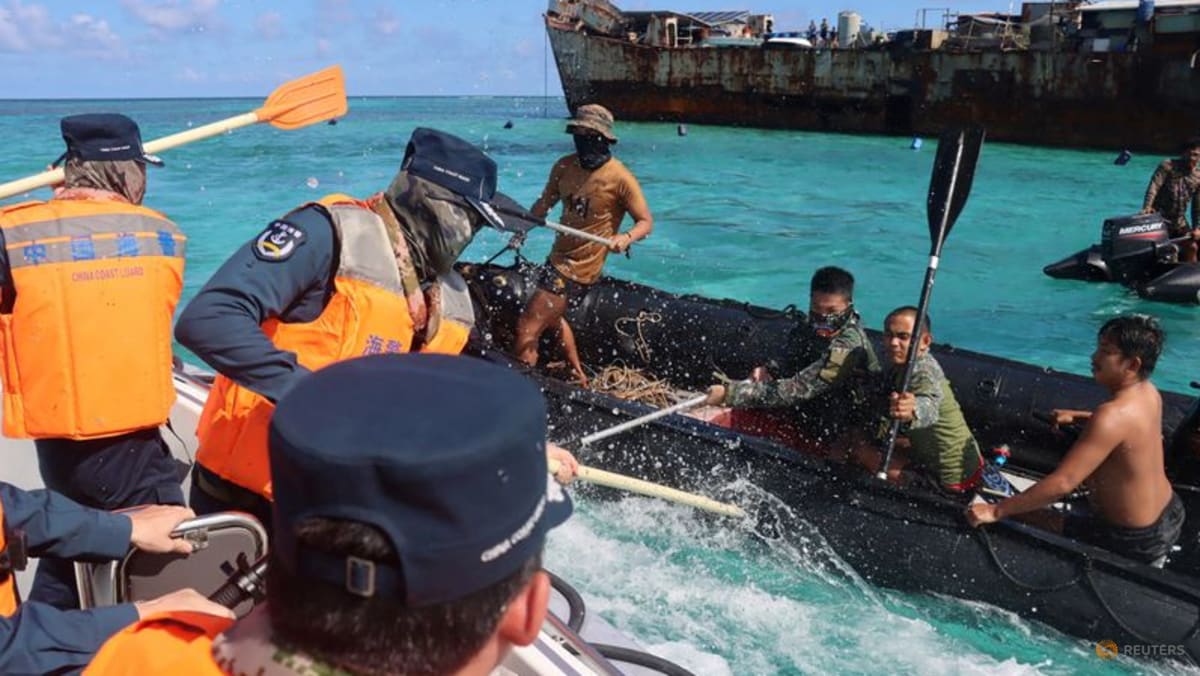
Clashes on the water have become sharper and more frequent since July. The most serious confrontation was on Jul 20, when Chinese Coast Guard personnel and Philippine marines fought with batons and paddles near Second Thomas Shoal, with a Filipino marine receiving a serious blow to the head. Most recently on Friday (Sep 18), Chinese and Philippine vessels collided near Sabina Shoal.
The return of such regular clashes was all but inevitable.
China has long sought control in the disputed waters and its level of activity has notably increased across multiple sites this year. Its efforts appear more and more to be about turning its presence into what the Chinese Coast Guard calls more systematic “management and control” of the waters.
WHY CLASHES ARE RETURNING
Renewed confrontation was only a matter of time. The arrangement that allowed relative calm to prevail around Second Thomas Shoal since July 2024 managed disputes without resolving them.
Under that tacit agreement, the Philippines was able to complete 13 rotation and resupply missions to Second Thomas Shoal without physical interference. However, a reported condition was that Manila refrain from significant construction work to reinforce the rusting outpost, the grounded WWII-era transport ship BRP Sierra Madre which is in danger of falling into the sea.
Videos indicate the Jul 20 incident was triggered when Philippine marines confronted a Chinese Coast Guard vessel that had approached the Sierra Madre. China’s ambassador in Manila explicitly stated that the vessel had approached to surveil “some kind of construction work in the ship”.
China's Foreign Ministry reiterated on Jul 21 that it would permit humanitarian resupply missions – provided the Philippines provided prior notification – but would “resolutely stop” any attempt to “build fixed facilities or a permanent outpost”.
The Philippines cannot put off such work indefinitely if it wants to maintain its position at the shoal. Given the rapid decay of the Sierra Madre in the salty maritime environment, doing so could in effect entail abandoning a reef that lies squarely within the Philippines’ Exclusive Economic Zone under the United Nations Convention on the Law of the Sea (UNCLOS).
%3C/p%3E%3Cp%3EThe%20latest%20clashes%20also%20come%20around%20the%20time%20of%20the%2010th%20anniversary%20of%20the%202016%20arbitration%20ruling%20that%20China%E2%80%99s%20nine-dash%20line%20was%20unlawful%20as%20a%20claim%20to%20maritime%20space.%20Beijing%20has%20never%20accepted%20the%20ruling.%3C/p%3E%3Ch2%3EEVERY%20MOVE%20ADDS%20UP%3C/h2%3E%3Cp%3EThe%20broader%20direction%20is%20even%20clearer%20at%20Scarborough%20Shoal,%20where%20China%20has%20achieved%20practical%20on-water%20control%20by%20setting%20new%20rules,%20expanding%20its%20ability%20to%20enforce%20them%20and%20restricting%20access%20to%20the%20shoal.%3C/p%3E%3Cp%3EChina%20telegraphed%20its%20intent%20in%202025%20with%20its%20announcement%20of%20a%20%E2%80%9CHuangyan%20Dao%20National%20Nature%20Reserve%E2%80%9D%20covering%20significant%20sections%20of%20the%20shoal.%20Since%20then,%20Beijing%20has%20been%20steadily%20building%20the%20administrative%20and%20legal%20frameworks%20to%20make%20comprehensive%20%E2%80%9Cmanagement%20and%20control%E2%80%9D%20of%20the%20disputed%20atoll%20a%20reality.%3C/p%3E%3Cp%3EOn%20Aug%201,%20the%20Ministry%20of%20Natural%20Resources,%20National%20Forestry%20and%20Grassland%20Administration,%20China%20Coast%20Guard,%20and%20Hainan%20provincial%20government%20jointly%20issued%20management%20rules%20reserve.%20The%20rules%20establish%20a%20routine%20patrol%20system,%20authorise%20investigation%20and%20punishment%20of%20violations,%20prohibit%20unauthorised%20fishing%20and%20other%20activities%20%E2%80%93%20which%20in%20effect%20prevent%20Philippine%20fisherman%20from%20entering%20the%20reserve%20except%20under%20specified%20circumstances.%3C/p%3E%3Cp%3EData%20from%20the%20Asia%20Maritime%20Transparency%20Initiative%20show%20China%20has%20doubled%20its%20Coast%20Guard%20patrolling%20presence%20around%20Scarborough%20Shoal%20in%202025%20compared%20to%20the%20previous%20year.%20The%20same%20data%20indicate%20it%E2%80%99s%20on%20track%20to%20double%20it%20again%20in%202026.%20In%20April,%20China%20reinstalled%20a%20floating%20barrier%20across%20the%20entrance%20of%20the%20shoal.%3C/p%3E%3Cp%3ENor%20is%20all%20this%20an%20isolated%20episode.%20This%20is%20occurring%20alongside%20efforts%20to%20strengthen%20Chinese%20physical%20presence%20elsewhere%20in%20the%20South%20China%20Sea,%20including%20major%20new%20reclamation%20at%20Antelope%20Reef%20in%20the%20Paracel%20Islands.%3C/p%3E%3Ch2%3ECHALLENGE%20OF%20PUSHING%20BACK%3C/h2%3E%3Cp%3EThe%20question%20then%20is%20whether%20China%20will%20face%20any%20pushback.%3C/p%3E%3Cp%3EAlthough%20the%20United%20States%20has%20reaffirmed%20an%20%E2%80%9Cironclad%E2%80%9D%20commitment%20to%20the%20Philippines%E2%80%99%20defence,%20credibility%20of%20US%20deterrence%20in%20the%20South%20China%20Sea%20has%20been%20called%20into%20question.%20Not%20only%20has%20the%20war%20on%20Iran%20weakened%20the%20US%20military%20posture%20in%20East%20Asia,%20US%20President%20Donald%20Trump%20himself%20has%20repeatedly%20shown%20a%20willingness%20to%20negotiate%20with%20China%20over%20American%20regional%20security%20issues.%3C/p%3E%3Cp%3EThe%20last%20reported%20Freedom%20of%20Navigation%20Operations%20(FONOPs)%20%E2%80%93%20to%20challenge%20excessive%20maritime%20claims%20%E2%80%93%20in%20the%20South%20China%20Sea%20was%20in%20August%202025.%20There%20have%20been%20no%20publicly%20known%20US%20FONOPs%20since%20then.%3C/p%3E%3Cp%3EThis%20pause%20mirrors%20a%20pattern%20seen%20during%20Mr%20Trump%E2%80%99s%20first%20term%20when%20he%20sought%20to%20build%20a%20relationship%20with%20Chinese%20President%20Xi%20Jinping.%3C/p%3E%3Cp%3EThere%20are,%20however,%20signs%20that%20other%20countries%20with%20an%20interest%20in%20a%20balance%20of%20power%20in%20the%20region%20may%20be%20stepping%20up.%20Earlier%20this%20month,%20the%20UK%20said%20it%20had%20conducted%20a%20joint%20FONOP%20with%20Australia%20in%20the%20South%20China%20Sea.%20In%20May,%20the%20UK%20sailed%20a%20naval%20vessel%20through%20the%20Spratly%20Islands,%20as%20did%20the%20Dutch%20navy%20through%20the%20Paracel%20Islands.%3C/p%3E%3Cp%3EAmid%20budgetary%20squeezes,%20whether%20European%20navies%20can%20sustain%20such%20deployments%20and%20meaningfully%20compensate%20for%20the%20US%E2%80%99%20reduced%20attention%20is%20far%20from%20clear.%3C/p%3E%3Cp%3EThere%20will%20likely%20be%20no%20shortage%20of%20clashes%20in%20the%20coming%20years%20to%20test%20such%20commitments.%3C/p%3E%3Cp%3E%3Cem%3EAndrew%20Chubb%20is%20a%20Fellow%20on%20Chinese%20Foreign%20Policy%20and%20National%20Security%20at%20the%20Asia%20Society%20Policy%20Institute%E2%80%99s%20Center%20for%20China%20Analysis,%20and%20a%20Senior%20Lecturer%20at%20Lancaster%20University.%3C/em%3E%3C/p%3E%3Cp%3E%3Ci%3Esource:%20CNA%3C/i%3E%20%20%3Ca%20href=)
https://www.channelnewsasia.com/commentary/south-china-sea-philippines-clash-injury-control-6405116