
Investment alone not enough for ASEAN firms to capture opportunities: Gan Kim Yong
DPM Gan Kim Yong stated that ASEAN businesses must upgrade value chains, build capabilities, and upskill workers, as investment alone is insufficient to capture emerging opportunities.
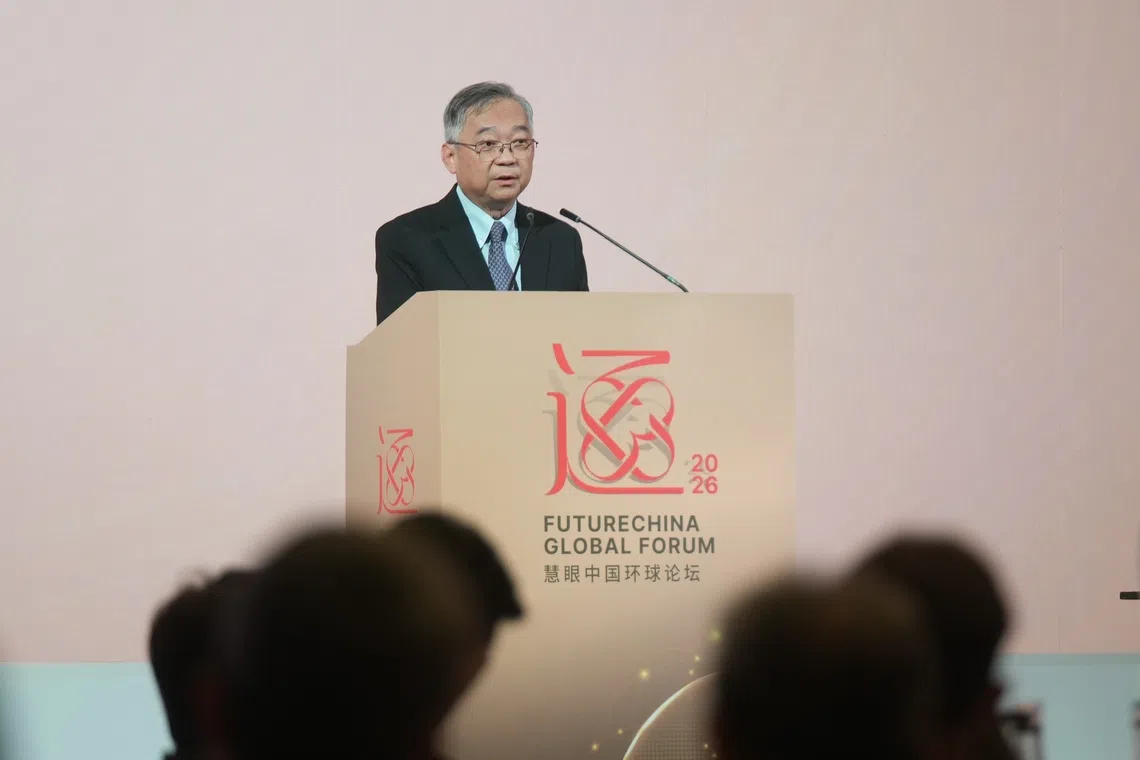
SINGAPORE – ASEAN faces a harder path to industrial upgrading, as its businesses are facing intensifying competition, with automation reducing the advantage of lower labour costs, said Deputy Prime Minister Gan Kim Yong.
This comes as digital platforms are introducing competition while opening up new markets for firms, added Gan, who is also Minister for Trade and Industry (Trade).
Delivering an opening keynote at the FutureChina Global Forum at the Sands Expo and Convention Centre on , he noted that businesses need more than investment to capture new opportunities.
“More trade and investment, by themselves, will not be enough,” he said. “We must also help local enterprises move up the value chain to benefit from these opportunities and workers acquire the skills needed to take on new roles.”
Gan added that developing a stronger and more resilient ASEAN should be a shared priority for Singapore and China. This is because a more prosperous region presents Singapore and Chinese businesses with growing markets, more resilient supply chains and stronger partners.
China has been ASEAN’s largest trading partner since 2009, while ASEAN has been China’s largest trading partner since 2019.
Trade between China and ASEAN exceeded US$1 trillion (S$1.28 trillion) for the first time in 2025, according to official statistics.
Since then, China and ASEAN recorded US$744.4 billion in trade in the first seven months of 2026. The region also accounted for almost 22 per cent of China’s total foreign trade over the same period, data from China’s Commerce Ministry showed.
Gan said the latest upgrade to the ASEAN-China Free Trade Area, which was formally signed in October 2025, is an opportunity for China and Singapore to work with ASEAN partners in areas including the digital and green economies, as well as supply chain connectivity.
Connectivity is a key part of the equation, he added, while pointing to the International Land-Sea Trade Corridor linking western China with South-east Asia and beyond.
Better transport links and supporting services can help ASEAN firms reach customers in China, and give logistics firms new business, Gan said.
These connections will also bring about new capabilities, he added, as investors can work with local suppliers to improve quality standards, methods and products.
Technology partners can also help smaller firms to adopt digital tools, while developing capabilities to adapt and maintain them.
Meanwhile, green projects can create opportunities to grow local enterprises and train workers.
Gan said: “The aim is not for every economy to do exactly the same thing. It is for businesses across the region to find a competitive niche in the value chains, and for workers to see pathways to progression.
“That is how regional integration becomes more relevant and resilient. When local firms gain customers and capabilities, and workers gain better opportunities, they will have a reason to support continued trade and investment.”
He also noted that open markets have been a powerful engine of development for Asia, but the model is under tremendous strain because of factors such as geopolitical rivalry.
Businesses and workers are also questioning whether they have received a fair share of benefits from growth and technological change.
Gan acknowledged that the concerns can fuel demands for protection, and cause economies to look inwards and close up.
However, he said protectionism can make it harder for businesses to reach new markets, acquire capabilities and seize new opportunities. He added: “We cannot simply counter openness by closing up. We have to make openness work better for businesses and for people.”
One way to do this is by making openness more resilient, by building stronger capabilities at home while expanding connections abroad.
Gan said people and businesses should also be given a stake in the progress and prosperity of countries.
He added that Singapore will work with ASEAN member states to deepen integration and strengthen the group’s capacity to respond to change as it assumes the ASEAN chairmanship in 2027. Singapore is set to take over the role from the Philippines on Jan 1.
Gan said: “We want an ASEAN that remains open to the world, with the capabilities, connections and agency to shape our own future.
“Singapore and China have spent decades building trust through mutually beneficial cooperation. We should now draw on that trust to build capabilities – in Singapore and across ASEAN.”
Separately, ASEAN also came up as a topic of interest during a fireside chat with Defence Minister Chan Chun Sing – moderated by Lee Huay Leng, editor-in-chief of SPH Media’s Chinese Media Group – at the forum on .
Responding to a question from the audience about what worries he has about ASEAN, Chan, who is also Coordinating Minister for Public Services, said his business-focused concern for ASEAN is its need to be a market with less friction across its financial system, data infrastructure and ecosystem, and energy system.
He said: “These three (systems), to me, are the commanding heights of any new economy. It is in ASEAN’s collective interest for us to work together, and it is in our interest to have the business people driving this closer integration.”
Chan added that Chinese President Xi Jinping’s first state visit to the US in more than a decade has so far shown that “both sides are trying their very best to manage their relationship, starting from the very top”.
“Hopefully, what we have seen at the very top, the effort to negotiate the complexities carefully, will also percolate to the lower echelons, officials, and across the entire system,” he said.
source: The Straits Times https://www.straitstimes.com/business/investment-alone-not-enough-for-asean-firms-to-capture-opportunities-gan-kim-yong