Singapore, Germany to expand industrial AI cooperation as part of updated 5-pillar work plan
Singapore and Germany expand industrial AI collaboration under an updated five-pillar work plan, strengthening joint efforts in advanced technology and innovation.
(Updated: 27 Oct 2026 03:13PM)
SINGAPORE: Singapore and Germany will make industrial artificial intelligence (AI) a bigger part of their economic partnership as part of an updated five-pillar work plan spanning security, trade and energy,the leaders of both nations said on Tuesday (Oct 27).
Speaking at a joint press conference at Parliament House with German Chancellor Friedrich Merz, Singapore Prime Minister Lawrence Wong said Singapore and Germany recognise the “enormous potential” of digital technologies and AI to transform economies.
AI can also create new opportunities for businesses and workers, he said, adding that the EU-Singapore Digital Trade Agreement that was signed in 2025 provides a foundation for cross-border digital transactions.
To this end, Mr Wong said both countries “now want to go further”.
“Particularly in the development and deployment of industrial AI, where the strengths of our two countries can complement each other,” he said.
Industrial AI is the application of machine learning, computer vision, and autonomous systems to physical operations, manufacturing plants, energy systems and supply chains.
Mr Merz, who is in Singapore for a two-day official visit, noted in German the high volume of international trade that passes through the region, describing it as an area where political, economic and technological forces are at play.
He said that he is visiting Singapore to deepen partnerships against this backdrop, noting that Germany also wants to have a say in major technological innovations.
The visit is his first since he was elected chancellor in 2025.
"We have to prepare ourselves for a world that is increasingly marked by insecurity, and we have to do so internally and externally. We want to safeguard our prosperity, our competitiveness, and we want to have a say in shaping the major technological revolutions," said Mr Merz.
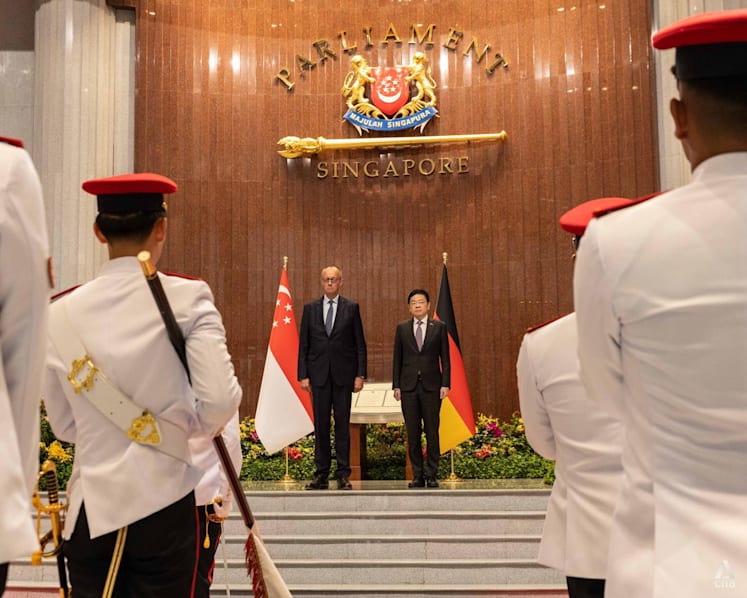
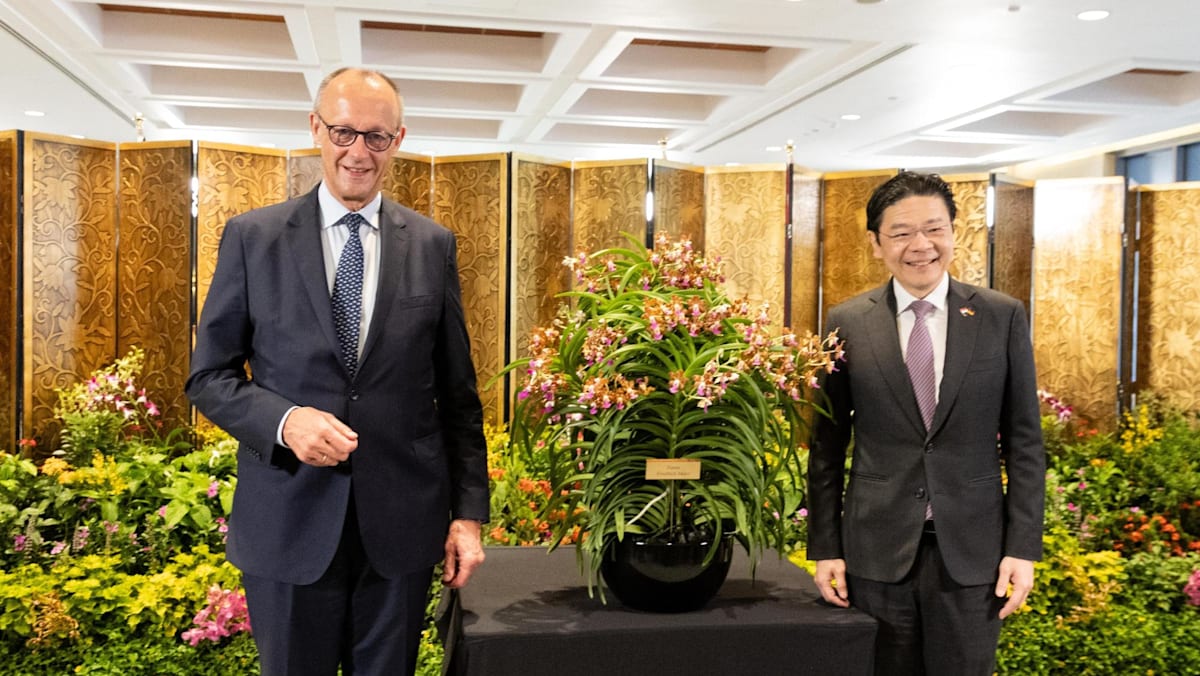
German Chancellor Friedrich Merz and Prime Minister Lawrence Wong at the Parliament House on Oct 27, 2026. (Photo: CNA/Ili Mansor)
Both countries elevated relations to a strategic partnership in November 2024, share strong economic and defence ties, and are mutual partners in advancing multilateralism. Among European Union nations, Germany is Singapore’s largest trading partner in goods and the third largest in services.
“Chancellor Merz and I both agree that there is much more we can do together under our strategic partnership,” said Mr Wong, adding that both countries have also agreed to the updated joint work plan, which includes defence and security; trade and urban development; digitalisation and AI; science and innovation; and climate and the green economy.
Responding to CNA's question on the opportunities for Singapore businesses and workers arising from closer ties with Germany, particularly in areas such as artificial intelligence and digitalisation, Mr Wong said that Germany and Singapore bring complementary strengths to the table.
"We are keen to develop these sorts of partnerships, and as we go about doing so, I'm sure it will open up new opportunities for Singapore companies," said Mr Wong, noting that the decades of partnerships have already benefited many Singaporean SMEs and workers.
Mr Wong said that in this new phase, many Singapore companies will benefit from partnering with German companies and the Mittelstand (German small and medium-sized enterprises). This, in turn, will create more jobs for Singaporeans, who will gain skills and training as they take on these roles.
In February, both countries announced an ongoing “year of innovation” initiative, which placed AI and future technologies such as quantum, microelectronics and biotechnology as key focus areas, among other things.
"Singapore intends to build momentum and pursue more joint research and innovation projects in areas such as AI, advanced manufacturing, green technologies, semiconductors, quantum and space technologies," said Mr Wong.
At the same time, Singapore and Germany both recognise that AI poses new risks and challenges, he added.
"So even as we both cooperate on AI deployment, we can ensure that this is done in a way that remains safe, trusted and human-centred," said Mr Wong.
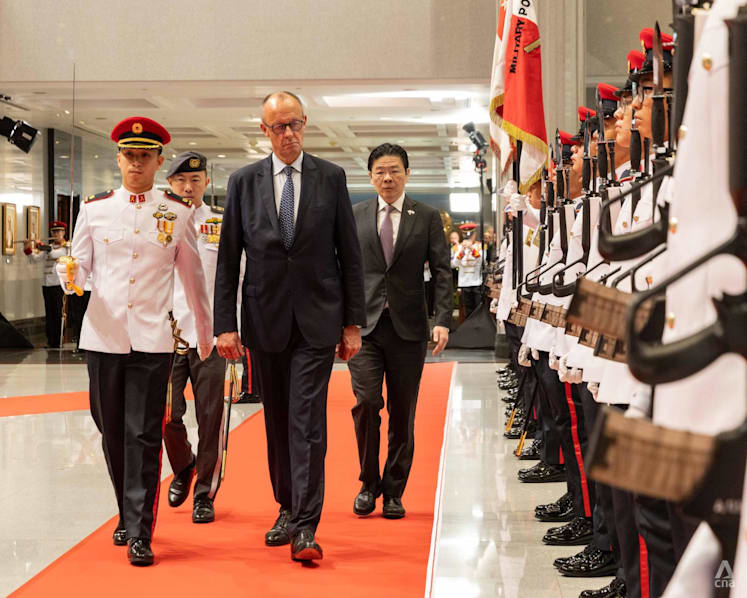
Prime Minister Lawrence Wong welcomes German Chancellor Friedrich Merz at the Parliament House on Oct 27, 2026. (Photo: CNA/Ili Mansor)
COMMITTED TO COOPERATION
Mr Wong said both countries share many common interests and convictions that have underpinned their friendship over the past six decades despite Singapore and Germany being "geographically far apart".
These shared convictions will bring the two countries closer together in a world that is becoming more uncertain and fragmented, he added.
"Singapore and Germany are both deeply connected to the global economy. We depend on open markets and strong international partnerships," said Mr Wong.
"The zeitgeist is turning against openness and trade. But our response cannot be to turn inwards. Instead, we want to work with like-minded partners to build new connections," said Mr Wong.
Responding to a question on whether both leaders are in favour of EU and Germany joining the Comprehensive and Progressive Agreement for Trans-Pacific Partnership (CPTPP), Chancellor Merz said Germany has long wanted to deepen ties with countries in the trade pact.
The CPTPP is a major multilateral free trade agreement among 12 Pacific Rim economies.
He said Germany is looking for partners that support free international trade and a rules-based international order.
"This is why we're engaging with Singapore and other partners and countries in the region, which we believe to be grateful partners," said Mr Merz.
"A restriction of global trade is taking place. We want to do it in a different way. We want to prove that we can do it better."
To this, Mr Wong said Singapore and Germany are "natural partners" in upholding the international rules-based order.
"We believe that countries, large and small, benefit from a world where rules are respected, commitments are honoured, and disputes are resolved peacefully.”
He then cited Germany’s endorsement of the Guiding Principles for Underwater Infrastructure Defence Exchanges (GUIDE), a voluntary framework by 17 nations including Singapore to safeguard critical underwater infrastructure, such as telecommunications, energy and pipeline systems.
GUIDE is one practical example of how countries can work together to support multilateral frameworks and initiatives, said Mr Wong.
Germany became an ASEAN Sectoral Dialogue Partner in July. Mr Wong said this marked an important step towards strengthening ties between Germany and Southeast Asia.
"As ASEAN Chair next year, Singapore will work to deepen ASEAN’s partnerships with both Germany and the EU, including by making progress towards an ASEAN-EU Free Trade Agreement," said Mr Wong.
ASEAN and the EU will also mark 50 years of Dialogue Relations during Singapore’s ASEAN Chairmanship next year.
Responding to a question about whether political instability in Europe could affect investor confidence, Mr Wong and Mr Merz agreed on Germany's long-term investment prospects.
Mr Wong noted that Singaporean investors, including the country's sovereign wealth funds, have long invested in Germany and will continue to invest in Germany and Europe's longer-term potential.
"Our investors are long-term investors. They are not just investing for one election cycle; they are investing for the long term. Singapore believes in the longer-term potential of Germany and Europe, and we remain confident in that, and we continue to invest," said Mr Wong.
Mr Merz said he had assured Mr Wong during their discussions that Germany would protect property and investments, and remain a stable and trustworthy partner for cooperation and development.
Following the joint press conference, Mr Merz will call on President Tharman Shanmugaratnam and be hosted to lunch by Senior Minister Lee Hsien Loong.
In the afternoon, Mr Merz will deliver the 49th Singapore Lecture, organised by the ISEAS-Yusof Ishak Institute.
Mr Wong will also host a dinner in the chancellor’s honour.