Singapore labour market expands in Q2 even as retrenchments rise and job vacancies fall

Singapore's labor market expanded in Q2 2026 as employment grew, despite falling job vacancies and retrenchments rising to a post-pandemic high.
Singapore labour market expands in Q2 even as retrenchments rise and job vacancies fall

SINGAPORE – Retrenchments in Singapore rose to a post-pandemic high in the second quarter of 2026, while job vacancies continued to fall.

The number of laid-off workers reached 4,620 in the second quarter, the highest level since the fourth quarter of 2020 during the Covid-19 pandemic. This means about two workers were retrenched for every 1,000 employees.

This is up from 3,830 retrenchments – or about 1.6 retrenched workers for every 1,000 employees – in the first quarter.

The increase was driven by businesses , Ang said MOM has not established how much AI is contributing to the rise of retrenchments, but that the ministry is studying it.
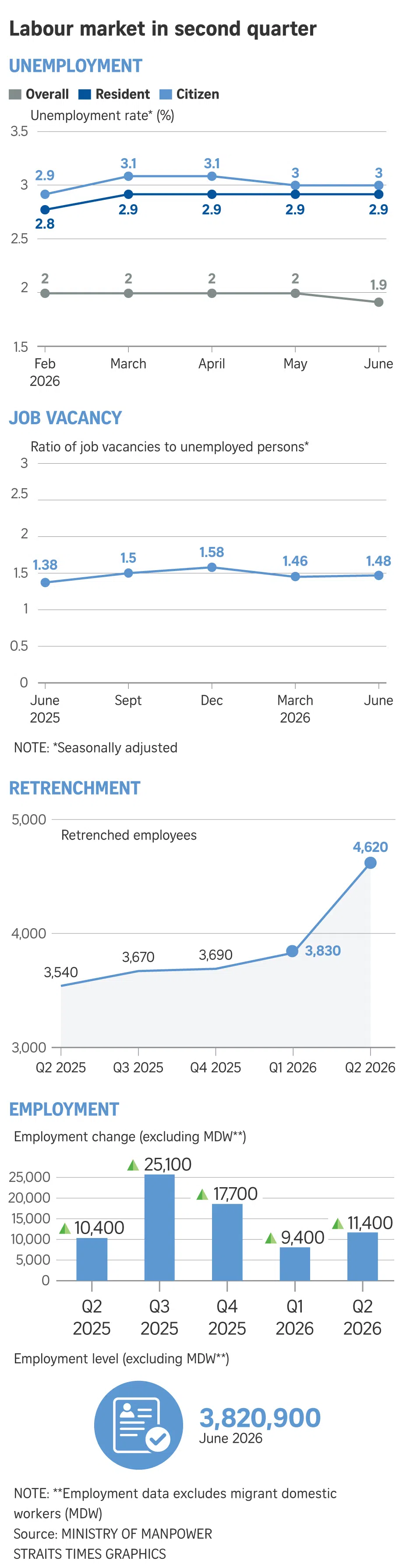
He said many companies listed reorganisation and restructuring as the reason for layoffs, although that could also involve AI adoption.However, he also noted that in other surveys, companies have said that they redesign job roles rather than reduce headcount when they adopt AI.Retrenched workers were also taking longer to find new jobs. The proportion of those who found employment within six months stood at 54.9 per cent in the second quarter,down from 60.7 per cent in the first quarter.However, close to 70 per cent of retrenched workers could find new jobs within a year.Acting Minister for Manpower Jasmin Lau said on the sidelines of a visit to technology company Acronis in Suntec Tower 3: “Some workers are finding that the transition into their next role is taking slightly longer. This is a concern for some Singaporeans. Now there are certainly still job opportunities, but moving from one job to the next can be challenging.”She added that the Government will support workers to learn and adapt, and to prepare for roles they can move into. This is done through career conversion programmes.“Instead of learning a new skill and then hoping to find a job that uses it, workers train for actual roles that companies need,” she said.“They learn on the job, gain real experience and build on the skills they already have.”Acronis has supported more than 50 of its employees since 2024 through career conversion programmes, building new skills in cybersecurity, software development and artificial intelligence.“This is the shift I hope we can all make together, learning new skills not just to protect what we have, but to open up more possibilities for what comes next,” Lau said.While retrenchments rose, the number of job vacancies fell to 68,600 in June, from 73,300 in March. This mainly reflects a drop in vacancies for professionals, managers, executives and technicians (PMETs) in sectors such as financial services and information and communications, the MOM report said.However, entry-level PMET vacancies remained “broadly stable and sizeable”, accounting for 45.3 per cent of all job openings in June.Despite the overall decline, there are still more job vacancies than unemployed people, with 1.48 vacancies per unemployed person as at June.Overall, Singapore’s labour market expanded in the second quarter, MOM said.Total employment rose by 11,400, marking the 19th consecutive quarter of growth, it noted.This was also an increase from the 9,400 jobs added in the first quarter.However, resident employment growth in the three months to June slowed from the previous quarter.Resident employment grew mainly in domestic-oriented sectors like transportation and storage, public administration and education, and health and social services, MOM said.Some outward-oriented sectors, such as professional services, financial services, and information and communications, also saw growth.Meanwhile, non-resident employment growth was driven by work permit holders in the construction and manufacturing sectors.Although the long-term unemployment rate edged up, unemployment rates remained “low and stable” in June, MOM said.The unemployment rate stood at 1.9 per cent overall and at 2.9 per cent for residents in June.The resident long-term unemployment rate rose slightly to 1 per cent in June, up from 0.9 per cent in March.MOM said: “Overall, the labour market remained resilient in the second quarter, with continued employment growth and low unemployment.“However, conditions became less favourable for some resident workers as resident employment growth moderated, retrenchments increased and six-month re-entry outcomes weakened.”Yang Li, partner for immigration at professional services firm Vialto, noted that retrenchments are indeed trending higher.“The more interesting insight is the combination of a rise in retrenchments occurring alongside continued employment growth. That suggests labour demand is shifting across sectors, functions and skill sets, rather than pointing to broad-based job reductions,” she said.Lewis Garrad, workforce and rewards leader for Asia at global professional services firm Marsh, said the market is still creating jobs, but matching is taking longer.“Open roles are more selective, skills requirements are shifting quickly, and employers are hiring more carefully,” he said, noting that global uncertainty is making companies more measured in workforce decisions.In addition, companies are increasingly hiring for adaptability, digital fluency and problem-solving, not just past job titles, he added.Leanne Chin, chief financial officer for the Asia-Pacific at human resources solutions firm ADP, said it is vital that companies develop their existing talent, especially as technology reshapes job roles, rather than eliminate them.“Targeted, on-the-job development tied to genuine career opportunities can help businesses address changing talent needs while giving workers greater confidence about where they fit in the future of work,” she added.Cautious outlook and softening labour marketLooking ahead, MOM said the labour market outlook is “positive but cautious”, according to its business expectation polls in July.The poll noted that near-term hiring expectations improved across more sectors, with the share of companies intending to hire in the next three months rising to 48.7 per cent in July, up from 43.9 per cent in June.However, the percentage of companies intending to raise wages fell to 27.9 per cent in July, down from 29.3 per cent in June.“Despite the improvement, both hiring and wage expectations remained below their February levels,” MOM added.DBS Bank senior economist Chua Han Teng said analysts expect Singapore’s labour market to remain “broadly stable” in the second half of 2026, supported by a cautiously resilient economic outlook, despite evolving and volatile geopolitical developments.“Although MOM’s forward-looking business expectation surveys in July 2026 showed an improvement in near-term hiring sentiment, it remains below pre-Middle East conflict levels,” he said.“Firms continue to pursue growth opportunities, but are also cautious regarding manpower expansion.”

Image 2

source: The Straits Times https://www.straitstimes.com/singapore/jobs/spore-labour-market-expands-in-q2-even-as-retrenchments-rise-and-job-vacancies-fall?utm_source=chatgpt.com